
Enabler
The engine doesn't just say no. It says how.
Credit decisioning built for markets where most applicants have no bureau file. Trained on your book and your market, not imported from someone else's.
Live · Pakistan
This is what it looks like in production.
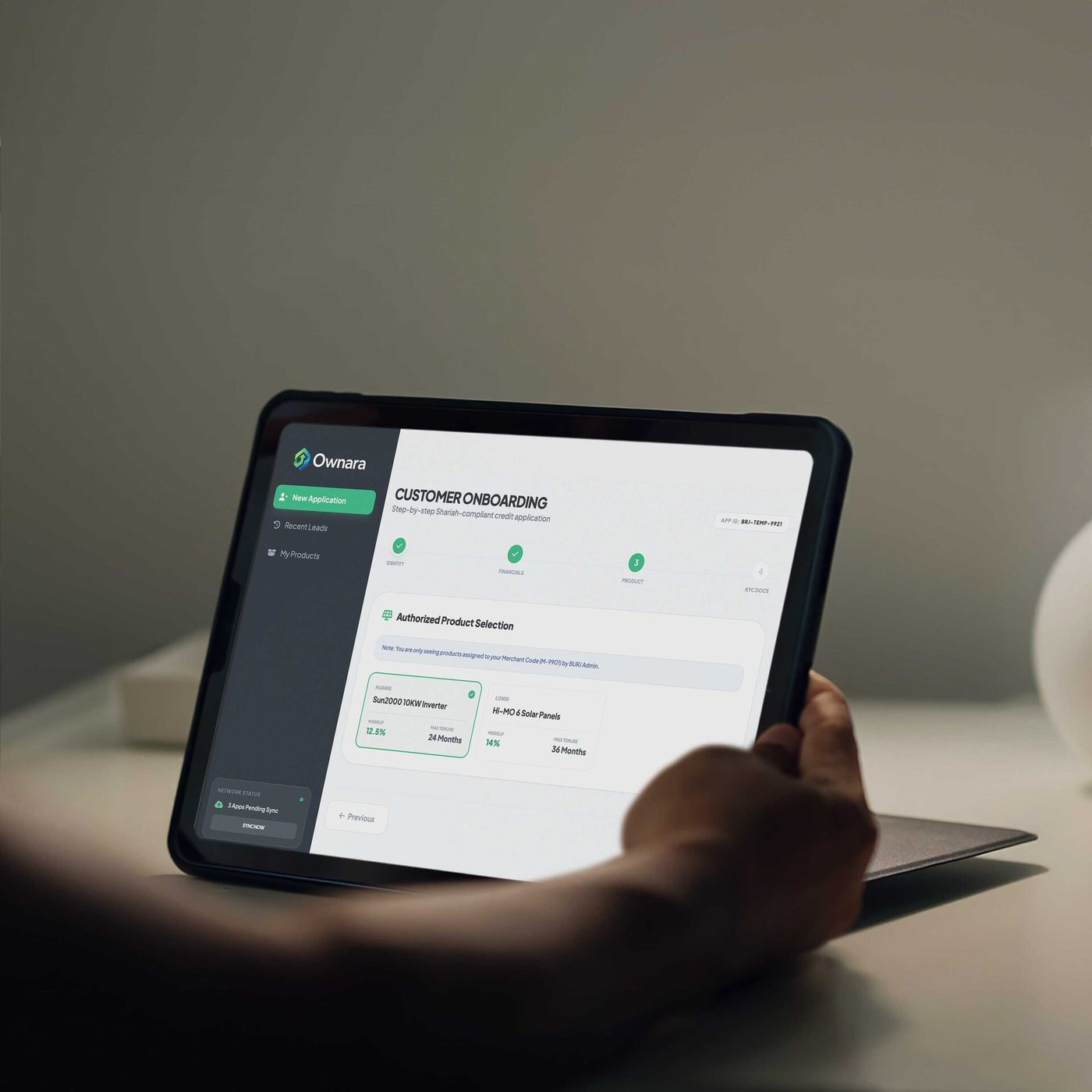
OWNARA runs Maly Score at the point of sale for Burj Clean Energy Modaraba — a sales agent opens the application on a tablet in the showroom, and the decision is back before the customer changes their mind.
The decision
One cut-off decides everything. We add the steps in between.
Today an application is scored against a single threshold and comes back approved or declined. The thin files fall below the line and are approved by a competitor within the week. A descending waterfall catches what the step above rejected.
- Approve at the requested limit
- Approve at a reduced limit
- Approve on a shorter tenor
- Approve with a guarantor carrying the exposure
- Approve secured against an existing holding
- Approve as a step-up line that grows as repayment behaviour proves out
- Route to a different product of yours, rather than to a competitor
Clears on the data.
Approved on different terms, not refused. This is where the book grows.
Fraud, compliance or genuine high risk. Still a firm no.
The engine changes what happens to files that fall below the line. It does not move where you draw the line.
What sits underneath
Evidence that does exist, instead of evidence that does not.
- Three years of audited accounts the company does not have yet
- Collateral the founders cannot pledge
- A bureau file that is empty by definition
- Declared income on a form
- National identity and mobile KYC
- Telecom usage and mobile money wallet behaviour
- Merchant and POS transaction history
- Receivables, and how reliably their customers pay
- Who backed them, and capital committed but not drawn
- Director and guarantor profile, including exposure you already hold
- On-site asset inspection with GPS and photo verification
Models are trained per market on the local book. Dynamic rules run per segment, so a salaried employee, a rider, an SME director and a young company are not measured against the same threshold.
What it changes
By converting customers instantly at the point where they decided to buy, rather than days later.
By replacing manual underwriting workflows with automated decisioning and exception handling.
Through AI-driven risk assessment and early-warning signals on the performing book.
Figures describe outcomes modelled and observed in merchant-led asset financing deployments. They are unaudited, describe past activity and are not a forecast.
How to test it
Retro-score your declines before you spend anything.
The fastest way to know whether this works on your book is to run it against decisions you have already made. Two weeks, no cost, no system touched.
- An NDA and a named sponsor inside the business
- Read-only access to 24 months of application and decision history
- Anonymised to your compliance team's standard
- Two hours with your credit committee once the numbers are back
How many of your past declines the engine would have converted, structured how, and at what expected loss. Your book, your numbers, not our case studies.
Live · Africa
Banked customers scored on bureau and banking data, mass market on telecom and merchant data, regulated high-value deals under local controls.
The waterfall, the data sources and the policy thresholds are rebuilt for each institution's book — not templated from someone else's market.
Start the conversation
Prove it on your declines.
Phase one takes two weeks, costs nothing and produces the business case for everything after it.